

 A100 SXM4 40GB

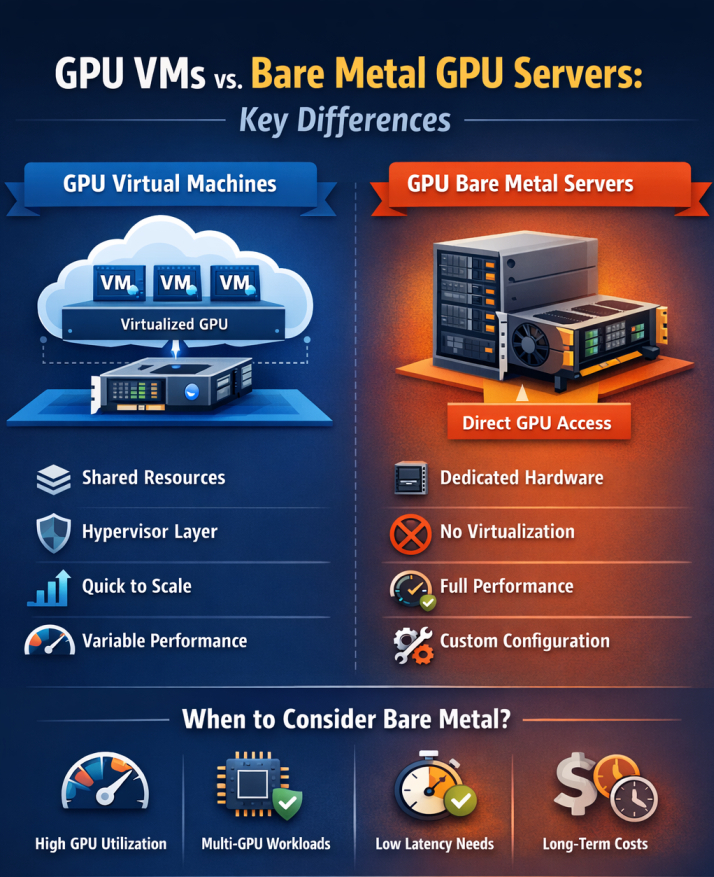
As GPU-powered workloads grow in scale and complexity, many teams reach a crossroads: should we continue using GPU virtual machines, or is it time to move to bare metal GPU servers?
There’s no one-size-fits-all answer. Most organizations begin with GPU VMs for good reasons, but as workloads mature, performance, cost, and predictability often push teams toward bare metal. This article breaks down when and why that shift makes sense, without hype just practical guidance.
As AI, machine learning, and high-performance computing workloads continue to grow, many teams eventually face a critical infrastructure decision: should we keep running on GPU virtual machines, or is it time to move to GPU bare-metal servers?
GPU VMs are an excellent starting point, but they are not always the final destination. As workloads mature, performance predictability, cost efficiency, and hardware control often become more important than flexibility alone. This article explains when moving from GPU VMs to bare metal makes sense, and how to make that decision with confidence.
GPU VMs vs GPU Bare-Metal Servers: An Overview
GPU virtual machines (GPU VMs) run on shared physical infrastructure using a virtualization layer to allocate GPU, CPU, and memory resources. They are easy to deploy, scale quickly, and work well for dynamic workloads.
GPU bare-metal servers provide direct access to physical GPUs without a hypervisor. You get full control of the hardware, operating system, drivers, and performance tuning.
Both models are valuable—but they serve different stages of workload maturity.
Why Most Teams Start with GPU VMs
Teams typically choose GPU VMs first because they offer:
- Rapid provisioning
- Elastic scaling
- Lower operational complexity
- Pay-as-you-go pricing
- Ideal environments for development and experimentation
For early-stage AI projects, proof-of-concepts, or short training jobs, GPU VMs reduce time to value and eliminate infrastructure overhead.
Core Architectural Differences and Resource Allocation
The real difference between GPU VMs and bare metal lies in how resources are accessed.
With GPU VMs:
- GPUs are accessed through virtualization or pass-through layers
- CPU, memory, and I/O paths are abstracted
- Performance can vary depending on host utilization
With bare metal:
- GPUs are physically attached
- No hypervisor interference
- Direct access to PCIe lanes, NUMA nodes, and memory channels
As workloads grow, these architectural differences become more impactful.
Performance Overhead Introduced by Virtualization
Even with modern GPU virtualization, some overhead is unavoidable. Virtual machines may experience:
- Slight reductions in GPU memory bandwidth
- Increased latency between CPU and GPU
- Limited inter-GPU communication efficiency
- Variability due to shared host resources
For light or short-lived workloads, this overhead is negligible. For intensive or long-running workloads, it becomes increasingly noticeable.
Benefits of Full Hardware Access on Bare Metal
GPU bare-metal servers unlock:
- Maximum GPU utilization
- Lower and more consistent latency
- Full access to GPU memory bandwidth
- Optimized multi-GPU communication
- Predictable performance for production workloads
This makes bare metal ideal for workloads that push GPUs to their limits.
Signs That GPU VM Performance Is Becoming a Bottleneck
-
Sustained High GPU Utilization
If your GPUs run at high utilization for extended periods, virtualization overhead begins to impact efficiency and cost.
-
Latency-Sensitive or Real-Time Workloads
Inference pipelines, real-time AI processing, and interactive applications benefit from bare metal’s lower and more stable latency.
-
Multi-GPU Workloads with NVLink or High PCIe Bandwidth
Large-scale model training often relies on fast GPU-to-GPU communication. Bare metal enables full NVLink and PCIe performance without abstraction layers.
-
Predictability and Performance Consistency
Production environments often require the same performance every run. Bare metal removes the variability inherent in shared virtualized environments.
Cost Comparison for Long-Running GPU Workloads
GPU VMs are cost-effective for:
- Bursty workloads
- Short training jobs
- Development and testing
- Unpredictable usage patterns
Bare metal becomes more economical when:
- GPUs run continuously
- Workloads are steady and predictable
- VM overhead premiums accumulate over time
For long-running AI training or HPC jobs, dedicated hardware often delivers better value.
Workloads Best Suited for GPU Bare Metal
Bare metal is a strong fit for:
- AI and deep learning training
- Large language model (LLM) fine-tuning
- High-performance computing (HPC)
- Scientific simulations
- Video processing and batch inference
These workloads demand consistent performance and high throughput.
GPU Memory, Bandwidth, and Interconnect Considerations
Modern GPU workloads are increasingly constrained by data movement rather than raw compute. Bare metal provides:
- Full GPU memory bandwidth
- Optimized PCIe throughput
- Unrestricted NVLink communication
- Reduced inter-GPU latency
This is critical for distributed and multi-GPU training environments.
Custom OS, Kernel, and Driver Configuration Needs
Bare metal allows complete control over:
- Operating system selection
- Linux kernel tuning
- NVIDIA driver and CUDA versions
- Specialized libraries and frameworks
This flexibility is essential for advanced optimization and compatibility requirements.
Compliance, Security, and Data Isolation Requirements
For regulated industries or sensitive data, bare metal offers:
- Physical isolation
- Stronger data sovereignty
- Reduced attack surface
- Easier compliance with strict security frameworks
These advantages make bare metal appealing for enterprise and government workloads.
Operational Control and Hardware-Level Tuning
Bare metal enables deep optimization, including:
- CPU pinning and NUMA alignment
- GPU power and thermal tuning
- BIOS and firmware optimization
- Network stack customization
These adjustments can unlock meaningful performance gains when managed correctly.
Scalability Trade-Offs Between GPU VMs and Bare Metal
GPU VMs scale quickly and horizontally.
Bare metal scales more deliberately but vertically.
While provisioning bare metal takes more planning, fewer high-performance nodes often outperform many smaller virtualized instances for mature workloads.
Hybrid Deployment Models: Combining GPU VMs and Bare Metal
Many organizations adopt a hybrid approach:
- GPU VMs for development, testing, and burst inference
- GPU bare metal for training and production workloads
This model balances flexibility, performance, and cost efficiency.
Migration Readiness and Operational Maturity
Before moving to bare metal, consider:
- Is the workload stable and well-understood?
- Are performance metrics clearly defined?
- Does the team have operational expertise?
- Is monitoring and automation already in place?
Bare metal works best for teams that have moved beyond experimentation.
When GPU VMs Remain the Better Choice
GPU VMs are still ideal when:
- Workloads are intermittent
- Infrastructure needs change frequently
- Speed and simplicity matter more than peak performance
- Teams want minimal operational responsibility
Not every workload needs bare metal—and that’s okay.
A Practical Decision Framework
Stay with GPU VMs if:
- GPU usage is irregular
- Rapid scaling is required
- Performance variability is acceptable
Move to GPU bare metal if:
- GPUs are consistently highly utilized
- Performance consistency is critical
- Multi-GPU communication is a bottleneck
- Long-term costs favor dedicated hardware
- Full system control is required
Final Thoughts
Moving from GPU VMs to bare metal isn’t about choosing “bigger servers.”
It’s about knowing when flexibility should give way to control, consistency, and efficiency.