

 A100 SXM4 40GB

Introduction: Immersion in the Age of Cloud Gaming
Gaming has come a long way, from bulky physical consoles and cartridge-based systems to powerful PCs and now fully cloud-powered experiences. In the past, immersion depended almost entirely on the hardware sitting in your living room. Today, that paradigm is shifting.
Modern gaming immersion increasingly relies on cloud GPUs rather than local hardware. With rendering, physics simulation, AI behavior, and ray tracing happening in powerful data centers, players can experience ultra-realistic worlds on devices that would have struggled to run even basic games a few years ago.
What Is a GPU Virtual Machine?
A GPU Virtual Machine (GPU VM) is a cloud-based virtual server equipped with a dedicated or shared Graphics Processing Unit (GPU). Unlike traditional virtual machines that rely only on CPUs, GPU VMs are optimized for high-performance graphics rendering, parallel processing, and AI workloads.
GPU Virtualization: How It Works
- GPU Passthrough: A physical GPU is assigned exclusively to one VM, delivering near-native performance.
- Shared GPU (vGPU): A single physical GPU is partitioned and shared across multiple VMs using virtualization technology.
Traditional VM vs GPU VM
A traditional virtual machine primarily focuses on CPU-based processing, making it suitable for general computing tasks such as web hosting, databases, and standard business applications. Its graphics capabilities are limited because it lacks access to dedicated GPU resources, making it unsuitable for high-end gaming or advanced graphics workloads. Gaming support on traditional VMs is minimal, and while they can handle basic AI or machine learning tasks, performance is restricted due to the absence of GPU acceleration.
In contrast, a GPU virtual machine combines both CPU and GPU power, enabling high-performance parallel processing and advanced rendering capabilities. With access to dedicated or virtualized GPUs, these VMs support high-end graphics rendering and are fully capable of running AAA games smoothly. They are also optimized for GPU-accelerated AI and machine learning workloads, delivering significantly faster computation for tasks such as real-time simulations, deep learning, and complex visual effects. In essence, GPU VMs transform standard cloud servers into powerful gaming and AI engines.
Why GPU VMs Matter for Modern Gaming
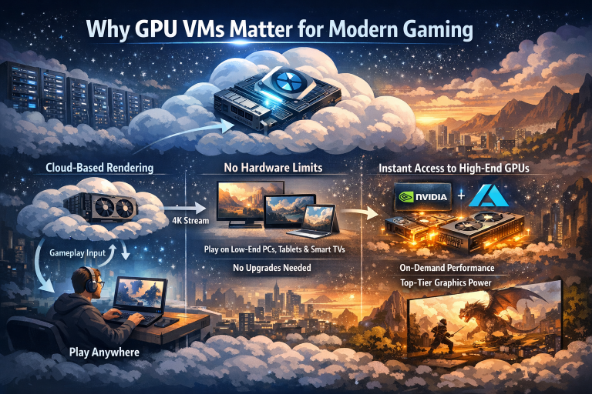
Modern games demand enormous computational power. Photorealistic graphics, real-time physics, ray tracing, AI-driven characters, and expansive open worlds all require hardware that can process millions (sometimes billions) of calculations per second. GPU Virtual Machines (GPU VMs) fundamentally change how this power is delivered to players.
Offloading Heavy Rendering to the Cloud
Traditionally, all rendering happens on the gamer’s local device. The GPU inside a PC or console processes textures, lighting, shadows, reflections, physics effects, and frame composition in real time. This requires expensive, power-hungry hardware.
With GPU VMs, the rendering workload shifts entirely to powerful cloud data centers.
- The game runs on a high-performance GPU inside a cloud server.
- The GPU processes all graphics, physics, and AI calculations remotely.
- The rendered frames are compressed into a high-quality video stream.
- That stream is delivered to the player’s device over the internet.
- The player’s inputs (keyboard, mouse, controller) are sent back to the cloud server in milliseconds.
This model transforms the user’s device into a display and input terminal rather than a processing engine. The heavy computational burden, ray tracing, high-resolution textures, and advanced particle systems are handled by enterprise-grade GPUs in the cloud.
Eliminating Hardware Limitations
Modern AAA games often require the latest GPUs to run at high settings. Gamers typically face:
- Expensive GPU upgrades every few years
- Compatibility issues with new titles
- Storage limitations
- Thermal and power consumption concerns
GPU VMs eliminate these constraints. Because the game runs remotely:
- Even low-end laptops can stream ultra settings.
- Tablets, smart TVs, and older desktops can access modern titles.
- Users no longer worry about GPU shortages or inflated hardware prices.
- There is no need to manually upgrade graphics cards.
This democratizes high-end gaming. A player with a basic internet-connected device can access the same graphical fidelity as someone with a premium gaming rig.
It shifts gaming from a hardware-dependent experience to a network-dependent service.
Instant Access to High-End GPUs
Purchasing a high-performance GPU can be costly and sometimes difficult due to supply shortages. GPU VMs solve this by offering high-end hardware on demand.
Cloud providers such as:
- NVIDIA (through cloud GPU infrastructure and virtualization technologies)
- Microsoft Azure (via GPU-enabled virtual machine instances)
allow users and platforms to deploy powerful GPUs instantly. Instead of investing thousands of dollars upfront, users or gaming platforms can:
- Rent GPU power by the hour
- Scale resources up or down based on demand
- Access the latest GPU architecture without physical installation
For gaming platforms, this means they can dynamically allocate GPU resources during peak hours and reduce usage during low traffic periods. For gamers, it means instant access to top-tier hardware without ownership.
Visual Realism Delivered from the Cloud
Ray Tracing via GPU VMs
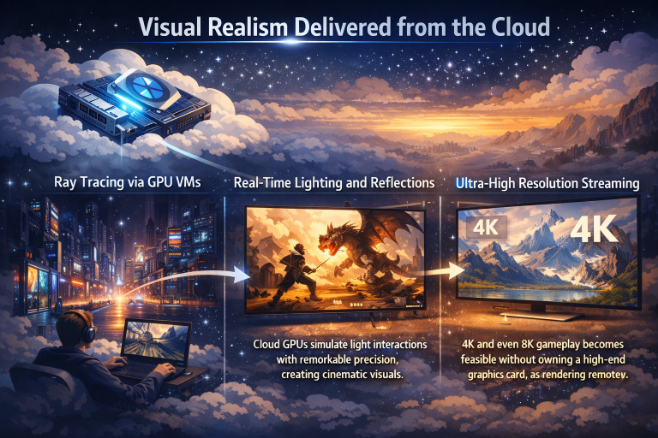
Modern cloud GPU infrastructure, powered by innovations from NVIDIA, enables real-time ray tracing directly in the cloud. This technology simulates how light physically behaves—calculating reflections, refractions, and shadows with extreme accuracy. As a result, games achieve movie-level realism without requiring players to own expensive GPUs.
Real-Time Lighting and Reflections
Cloud GPUs process complex lighting interactions instantly, including dynamic shadows, global illumination, and reflective surfaces. Whether it’s sunlight bouncing off water or neon lights reflecting in a rainy city street, every detail is rendered with cinematic precision. This creates deeper immersion and more believable virtual environments.
Ultra-High Resolution Streaming
Because rendering happens on powerful remote GPUs, games can be streamed in 4K and even 8K resolution to supported devices. Players don’t need high-end graphics cards—only a stable internet connection. The cloud handles the heavy graphical workload while delivering ultra-sharp visuals seamlessly to the screen.
Low Latency and High Frame Rates in Cloud Environments
Immersion in cloud gaming is not defined by visuals alone; it heavily depends on responsiveness and low latency.
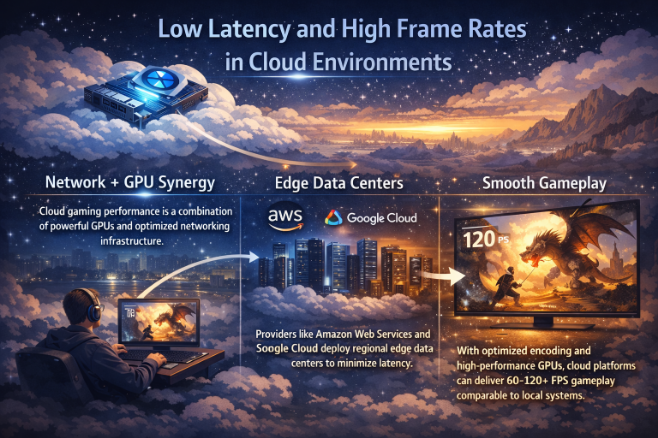
The seamless interaction between powerful cloud GPUs and high-speed networking infrastructure ensures that player inputs are transmitted instantly and rendered frames are delivered without noticeable delay.
Major providers such as Amazon Web Services and Google Cloud deploy regional edge data centers to reduce the physical distance between servers and players, minimizing latency. Combined with optimized video encoding and high-performance GPUs, this enables smooth 60–120+ FPS gameplay that closely matches the feel of playing on a local machine.
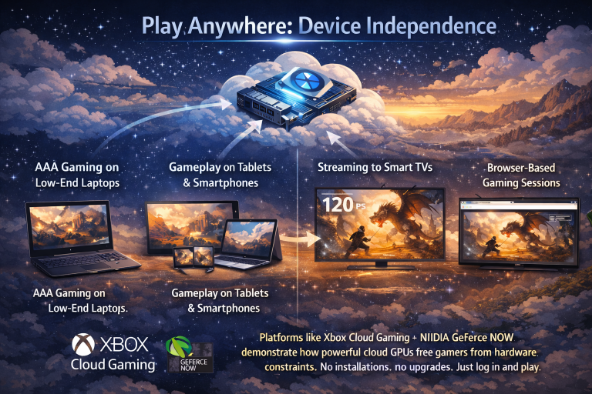
Play Anywhere: Device Independence
GPU VMs enable:
- AAA gaming on low-end laptops
- Gameplay on tablets and smartphones
- Streaming to smart TVs
- Browser-based gaming sessions
Platforms like Xbox Cloud Gaming and NVIDIA GeForce NOW demonstrate how powerful cloud GPUs free gamers from hardware constraints. No installations. No upgrades. Just log in and play.
Massive Multiplayer and Scalable Worlds
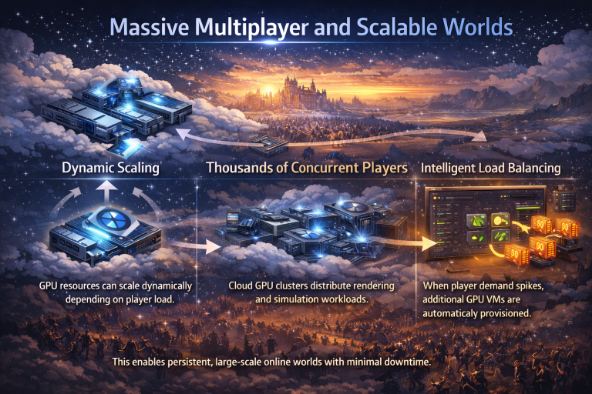
Dynamic Scaling
Cloud-based GPU infrastructure allows gaming platforms to automatically scale resources up or down based on real-time player activity. When more users join a game, additional GPU power is allocated instantly to maintain performance. This elasticity ensures consistent frame rates and smooth gameplay without overloading servers.
The chart below demonstrates how cloud GPU infrastructure maintains performance under increasing user demand compared to traditional setups.

Thousands of Concurrent Players
Cloud GPU clusters distribute rendering, physics calculations, and AI simulations across multiple virtual machines. Instead of relying on a single server, workloads are balanced across an entire infrastructure network. This makes it possible to support thousands, sometimes millions, of concurrent players in expansive online worlds.
Intelligent Load Balancing
Advanced orchestration systems continuously monitor player demand and server performance. During traffic spikes, new GPU VMs are automatically provisioned to prevent lag or downtime. This intelligent distribution of resources ensures stable, persistent, and large-scale multiplayer environments with minimal interruptions.
VR, AR, and the Metaverse on GPU VMs
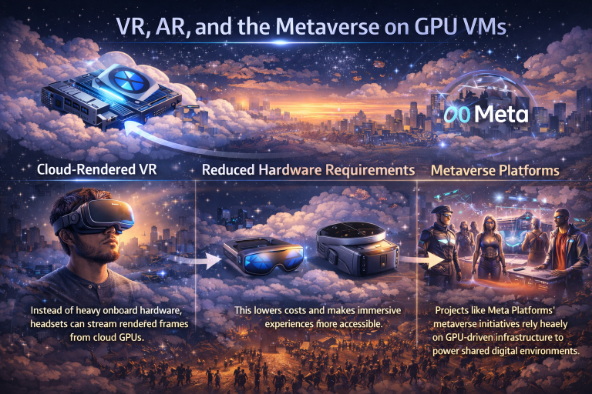
Cloud-Rendered VR
Virtual Reality requires extremely high frame rates and detailed 3D rendering to avoid motion sickness and maintain immersion. With GPU VMs, complex scenes are rendered in powerful cloud data centers instead of inside the headset. The rendered frames are streamed in real time to the device, delivering high-quality visuals without requiring bulky onboard hardware.
Reduced Hardware Requirements
Because the heavy processing happens in the cloud, VR and AR devices no longer need expensive, high-performance GPUs built in. This reduces the size, heat generation, and cost of headsets and AR glasses. As a result, immersive technologies become more affordable and accessible to a wider audience.
Metaverse Platforms
Large-scale virtual worlds, often described as the metaverse, require massive GPU infrastructure to render shared environments, avatars, physics, and real-time interactions. Companies like Meta Platforms rely on GPU-driven cloud systems to power persistent digital spaces. GPU VMs enable these environments to scale dynamically while supporting millions of simultaneous users in real time.
AI-Driven Immersion Using Cloud GPUs
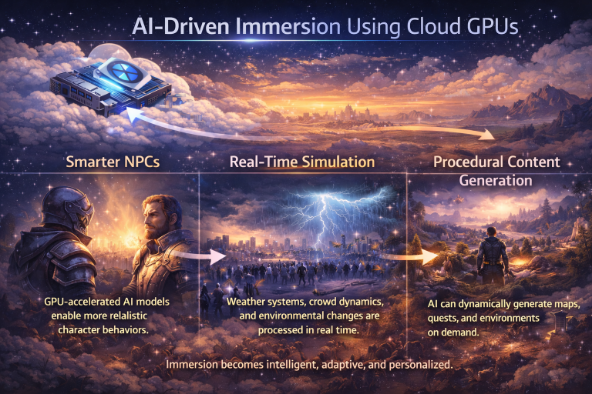
Smarter NPCs
Cloud GPUs accelerate advanced AI models that control non-player characters (NPCs), enabling them to react intelligently to player behavior. Instead of following repetitive scripts, NPCs can adapt, strategize, and even “learn” from in-game situations. This creates more lifelike interactions, believable dialogue, and dynamic combat scenarios that feel less predictable and more immersive.
Real-Time Simulation
GPU-powered AI can process complex simulations such as dynamic weather systems, realistic crowd behavior, physics interactions, and environmental destruction in real time. Rather than pre-programmed effects, the world evolves continuously based on player actions and system-driven variables. This makes game environments feel alive, responsive, and constantly changing.
Procedural Content Generation
With cloud-based AI acceleration, games can generate maps, missions, characters, and storylines dynamically as players explore. Instead of static worlds, environments expand and adapt on demand, offering unique experiences for every session. This reduces development limitations while delivering nearly endless content variety.
Intelligent, Adaptive Immersion
By combining AI processing with cloud GPU power, immersion becomes personalized and adaptive. The game can adjust difficulty, narrative paths, and environmental responses based on player style and decisions. The result is a gaming experience that feels tailored, evolving, and deeply engaging rather than fixed and repetitive.
Game Development on GPU Virtual Machines
Remote Teams
Cloud GPU workstations allow game studios and creative teams to collaborate seamlessly from anywhere in the world. Instead of relying on physical office hardware, developers, artists, and designers can access high-performance GPU environments through the cloud. This ensures consistent performance across teams and removes location-based limitations, enabling truly global production workflows.
Cloud-Based Rendering & Testing
With cloud GPUs, developers can render complex 3D scenes, process visual effects, and run large-scale simulations without depending on their local machines. Quality assurance (QA) teams can test builds across different configurations instantly using virtual environments. This flexibility reduces infrastructure costs while ensuring high-performance development and testing environments.
Faster Iteration
On-demand GPU scaling allows studios to instantly increase computing power during peak development phases. Tasks like rendering, compiling, and simulation that once took hours can be completed much faster. Shorter production cycles mean quicker updates, faster feature rollouts, and accelerated innovation in competitive gaming markets.

Cost Efficiency for Gamers and Studios
Pay-As-You-Go Models
Cloud GPU platforms operate on flexible, usage-based pricing, allowing gamers to pay only for the time or performance tier they use. Instead of investing in expensive graphics cards that may become outdated within a few years, players can access high-end performance instantly. This subscription or hourly model reduces financial barriers while keeping access to cutting-edge hardware.
The following comparison illustrates how cloud GPU subscriptions compare to traditional hardware ownership over a three-year period.

No Upfront Investment
For game studios, building and maintaining on-premise GPU infrastructure requires significant capital expenditure, including hardware, cooling, space, and maintenance costs. Cloud GPUs eliminate the need to purchase large GPU farms by offering scalable resources on demand. This shifts spending from heavy upfront investments to manageable operational expenses.
Better ROI
Startups and indie developers can launch high-quality games without spending millions on infrastructure. They can scale GPU usage based on player demand, avoiding wasted resources during low-traffic periods. This efficient allocation of computing power improves return on investment and lowers financial risk.
Democratizing High-End Gaming
By removing hardware barriers for both gamers and developers, cloud GPUs make premium gaming experiences accessible to a broader audience. High-performance graphics and large-scale game environments are no longer limited to those who can afford powerful local systems. Cloud infrastructure levels the playing field across the industry.

Security and Reliability
Isolated Environments
Each gaming session on a cloud GPU VM operates within its own isolated virtual environment. This separation prevents one user’s activity from affecting others and reduces the risk of cross-session vulnerabilities. Isolation also protects game data, user credentials, and in-session progress from unauthorized access or interference.
DDoS Protection
Cloud providers deploy advanced network security systems to defend against Distributed Denial-of-Service (DDoS) attacks. Traffic is monitored in real time, and malicious requests are filtered before they can disrupt gameplay. This enterprise-grade protection helps maintain stable connections, especially during high-profile launches or competitive events.
Backup and Disaster Recovery
Cloud infrastructure is built with redundancy across multiple servers and data centers. If hardware fails or a region experiences issues, workloads are automatically shifted to backup systems. This ensures minimal downtime, protects player data, and maintains continuous availability of gaming services.
Greater Stability for Players
By combining isolation, network security, and redundancy, cloud GPU platforms provide a more reliable gaming experience. Players encounter fewer crashes, interruptions, or service outages. The result is smoother, more stable gameplay across different devices and locations.

Sustainability and Green Gaming
Shared GPU Infrastructure
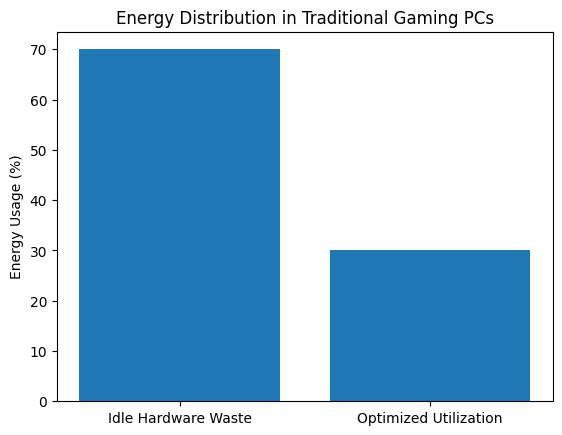
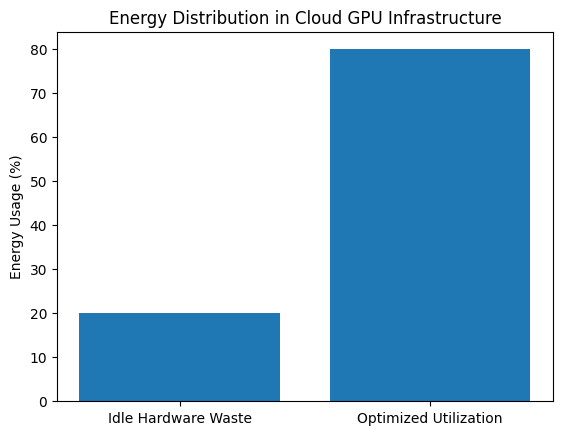
Cloud gaming shifts heavy processing from millions of individual gaming PCs to centralized GPU clusters in data centers. Instead of each gamer running a high-powered machine at home, resources are shared and allocated dynamically based on demand. This optimized utilization reduces overall idle hardware and improves energy efficiency across the ecosystem.
The energy distribution comparison below highlights how centralized cloud infrastructure improves overall utilization efficiency.
Energy-Efficient Data Centers
Major cloud providers design data centers with advanced cooling systems, power optimization technologies, and an increasing reliance on renewable energy sources such as solar and wind. Centralized facilities can operate far more efficiently than distributed home setups. This large-scale optimization significantly lowers the carbon footprint per gaming session.
Reduced E-Waste
Traditional gaming often requires frequent hardware upgrades as GPUs become outdated. Cloud gaming minimizes this cycle by extending the useful life of centralized hardware and reducing the need for individual replacements. Fewer discarded graphics cards and components translate into lower electronic waste and less environmental impact.
Supporting a Sustainable Future
By combining shared infrastructure, renewable-powered data centers, and reduced hardware turnover, cloud gaming promotes a more sustainable model for the industry. It balances performance demands with environmental responsibility. As adoption grows, this approach can meaningfully reduce the ecological footprint of high-end gaming.
Future Outlook: Fully Cloud-Native Gaming
The gaming industry is steadily moving toward a model where titles are designed specifically for cloud infrastructure rather than adapted from traditional PC or console environments. Fully cloud-native gaming represents a fundamental shift in how games are developed, deployed, and experienced.
Games Built Exclusively for GPU VMs
Future games will be architected directly for GPU virtual machines instead of relying on local hardware limitations. Developers will design engines that assume scalable, high-performance cloud GPUs are always available. This allows for massive real-time simulations, higher player counts, deeper AI integration, and environments that would be impossible to run on a single consumer device.
AI-Generated Worlds in Real Time
With powerful cloud GPUs accelerating AI models, entire game worlds can be generated and evolved dynamically. Landscapes, quests, characters, and story arcs may adapt continuously based on player behavior. Instead of static content updates, games could feel alive, expanding, transforming, and personalizing themselves in real time for every user.
Persistent Global Platforms
Cloud-native games can operate as persistent digital ecosystems rather than standalone titles. These platforms remain online continuously, evolving even when players log off. Massive shared environments, cross-device access, and synchronized progress across smartphones, PCs, consoles, and VR headsets become seamless and unified.
Redefining Creation, Scale, and Experience
Cloud-native gaming removes traditional hardware ceilings and infrastructure constraints. Developers gain virtually unlimited scalability, while players gain instant access to immersive worlds from any connected device. This evolution will not just enhance gaming performance; it will redefine how digital worlds are built, maintained, and experienced globally.
Conclusion
GPUs are no longer confined to personal PCs or gaming consoles; they now operate within powerful data centers distributed across the globe. Through GPU Virtual Machines, immersive gaming experiences become scalable, allowing performance to expand dynamically based on demand. Traditional hardware barriers fade away, enabling players to access high-end graphics without expensive upgrades. At the same time, AI-driven realism becomes a standard feature, enhancing worlds with intelligent characters, dynamic environments, and real-time simulations. Gaming is evolving into a service-based model, where performance and accessibility are delivered through the cloud. In this transformation, the GPU VM is not merely supporting modern gaming; it is emerging as the new console of the cloud era.