

 A100 SXM4 40GB

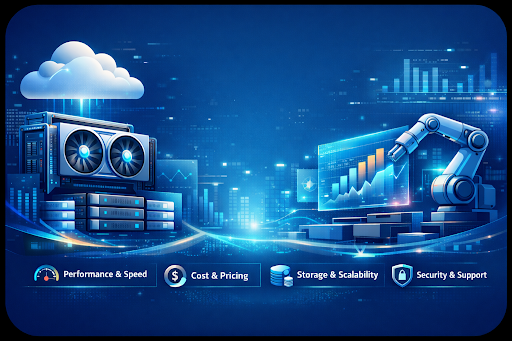
Data has become the backbone of modern businesses. From customer behavior analysis to operational monitoring and forecasting, organizations rely heavily on data-driven workloads to make informed decisions. As these workloads grow in complexity and scale, traditional CPU-based systems often struggle to keep up. This is where cloud GPUs step in.
Cloud GPUs are no longer limited to AI research or graphic design. Today, they play a crucial role in big data analytics, data engineering and ETL processes, and real-time data processing. However, choosing the right cloud GPU setup requires more than just selecting a powerful machine. Performance, pricing, storage, security, and deployment flexibility all need careful evaluation.
This blog explains the key aspects you should consider before selecting a cloud GPU for data-driven workloads.
1. Understanding Data-Driven Workloads
Data-driven workloads are systems and processes that rely on large volumes of data to generate insights, predictions, and operational decisions. Modern businesses use data to track customer behavior, monitor infrastructure, optimize operations, and forecast future trends.
Common characteristics of data-driven workloads include:
- Large datasets that grow continuously
- Repetitive and computation-heavy processing
- High demand for fast and reliable results
- Dependency on real-time or near-real-time analysis.
2. Why GPUs are used in Data-Driven
Unlike CPUs, which process tasks sequentially, GPUs are designed for massively parallel processing. This makes them particularly effective for workloads that involve repetitive calculations across large datasets.
In data-driven environments, GPUs help:
- Speed up analytical queries
- Reduce processing time for transformations
- Handle multiple data streams simultaneously
As data volumes increase, this parallelism can significantly improve efficiency and reduce overall execution time.
3. Types of GPU available for Data-Driven
- General-Purpose Compute GPUs – Suitable for a wide range of data analytics, ETL, and mixed data processing workloads.
- Compute-Optimised GPUs – Designed for compute-heavy data processing tasks requiring high parallel calculation power.
- Memory-Optimised GPUs – Best for data workloads that need to process large datasets directly in GPU memory.
- Analytics-Accelerated GPUs – Optimised for big data analytics and GPU-accelerated data processing frameworks.
- Streaming and Real-Time Processing GPUs – Ideal for handling continuous data streams with low latency and consistent performance.
- Entry-Level GPUs – Used for development, testing, and small-scale data processing workloads.
4. Matching GPU Selection with Workloads
-
Big Data Analytics
Big data analytics workloads typically involve scanning, filtering, and aggregating large datasets. These operations benefit from GPUs with:
- High memory bandwidth
- Adequate GPU memory (VRAM)
- Efficient parallel compute units
GPUs can process large data blocks concurrently, which helps analytics engines deliver faster results compared to CPU-only environments. This is especially useful for workloads that run complex queries across millions or billions of records.
-
Data Engineering and ETL Pipelines
Data engineering focuses on moving and transforming data between systems. ETL workflows often include:
- Data cleaning
- Format conversion
- Aggregations and joins
GPU acceleration can reduce processing time for transformation-heavy stages, especially when dealing with structured or semi-structured data. When selecting a GPU for ETL workloads, ensure it:
- Integrates well with your data tools
- Supports scalable processing
- Handles frequent read/write operations efficiently
This makes GPUs a strong choice for modern data pipelines that process data continuously.
-
Real-Time Data Processing
Real-time workloads demand immediate insights. Examples include monitoring systems, live dashboards, and event-driven analytics. In these cases, even small delays can affect outcomes.
For real-time data processing, GPUs should provide:
- Low-latency processing
- Consistent performance
- Fast communication with storage and network components
GPUs capable of handling multiple data streams simultaneously ensure that incoming data does not pile up during peak loads.
5. Understand the Cost Structure Carefully
Cloud GPU pricing is not limited to compute power alone. Many platforms calculate costs based on:
- GPU usage
- Network bandwidth consumption
- Storage allocation
Data-driven workloads frequently transfer large volumes of data, which can significantly affect bandwidth costs. Before selecting a GPU plan, review:
- Included bandwidth limits
- Charges for additional data transfer
- How costs scale as usage increases
Understanding the pricing structure upfront helps avoid unexpected expenses.
6. Storage Flexibility and Additional Volumes
Data-driven workloads depend heavily on storage performance. GPUs alone cannot deliver optimal results if storage becomes a bottleneck.
When evaluating a cloud GPU platform, check whether it supports:
- Attaching additional storage volumes
- Scaling storage independently from compute
- High-performance SSD or NVMe storage
ETL workflows and analytics jobs often require temporary storage for intermediate results. Flexible storage options ensure your workloads run smoothly without performance degradation.
7. Security and Access Control
Security is a fundamental requirement for any cloud deployment. Most GPU platforms rely on SSH key-based authentication instead of traditional passwords.
SSH keys offer:
- Stronger security
- Better control over user access
- Reduced risk of brute-force attacks
For teams managing multiple GPU instances, proper SSH key management ensures secure and controlled access to data processing environments.
8. Scalability for Future Data Growth
Data workloads rarely remain static. As data volume grows, your GPU infrastructure should scale without requiring major architectural changes.
A good cloud GPU platform should allow you to:
- Scale instances up or down easily
- Add GPUs as workload demand increases
- Adjust resources without downtime
Scalability ensures that your infrastructure evolves alongside your data strategy.
9. Reliability and Support
Finally, reliability plays a critical role in data-driven environments. Downtime during analytics or real-time processing can impact reporting, monitoring, and business decisions.
Look for providers that offer:
- Clear uptime guarantees
- Stable GPU availability
- Responsive technical support
Reliable infrastructure combined with strong support helps maintain consistent performance across workloads.
Conclusion
Choosing the right cloud GPU for data-driven workloads involves more than just raw performance. From understanding GPU types and workload requirements to evaluating cost models, storage options, security, and instance flexibility, every factor plays a role in long-term success.
Whether you’re running big data analytics, building ETL pipelines, or processing data in real time, a well-chosen cloud GPU setup can dramatically improve performance while keeping costs under control.
By focusing on practical needs rather than over-engineering, businesses can unlock the true value of cloud GPUs and build data platforms that are fast, secure, and scalable.