

 A100 SXM4 40GB

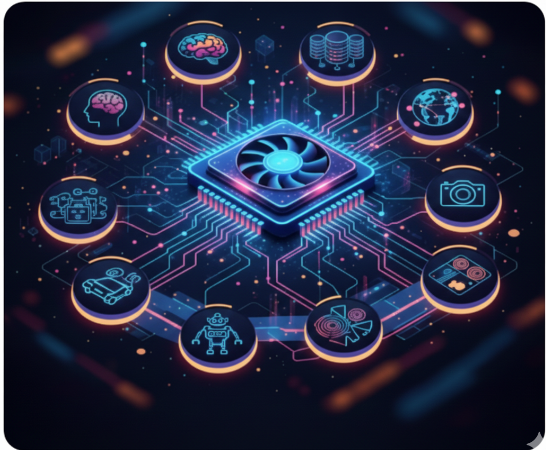
A Graphics Processing Unit (GPU) is a specialized processor designed to handle massively parallel operations. Unlike a CPU, which focuses on executing a few complex tasks sequentially, a GPU can execute thousands of smaller tasks simultaneously, making it exceptionally efficient for workloads that involve large-scale data processing.
Originally developed to accelerate graphics rendering for video games and visual applications, GPUs have evolved into foundational components of modern computing. Today, they play a critical role in:
- Artificial Intelligence (AI) and Machine Learning (ML)
- High-Performance Computing (HPC)
- Data analytics and simulations
- Video processing and rendering
- Scientific research and engineering
Modern technologies such as deep learning, autonomous vehicles, real-time analytics, digital twins, and generative AI would not be practical at scale without GPU acceleration. As workloads become increasingly data-intensive, GPUs are now considered essential infrastructure, not just graphics hardware.
What Does a GPU Do?
The graphics processing unit, or GPU, has become one of the most important types of computing technology, both for personal and business computing. Designed for parallel processing, the GPU is used in a wide range of applications, including graphics and video rendering. Although they’re best known for their capabilities in gaming, GPUs are becoming more popular for use in creative production and artificial intelligence (AI).
GPUs were originally designed to accelerate the rendering of 3D graphics. Over time, they became more flexible and programmable, enhancing their capabilities. This allowed graphics programmers to create more interesting visual effects and realistic scenes with advanced lighting and shadowing techniques. Other developers also began to tap the power of GPUs to dramatically accelerate additional workloads in high-performance computing (HPC), deep learning, and more.
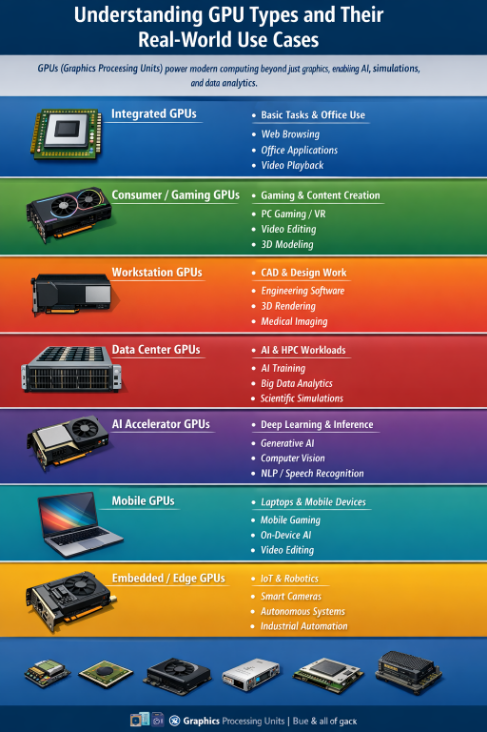
1. Integrated GPUs (iGPUs)
Integrated GPUs are built directly into the CPU and share the system’s main memory (RAM). They are designed for general-purpose graphics and compute tasks where power efficiency and cost are more important than raw performance.
Because they share resources with the CPU, integrated GPUs have limited memory bandwidth and parallel compute capability compared to discrete GPUs.
Key Characteristics
- No dedicated video memory
- Uses system RAM
- Low power consumption
- Minimal heat output
Real-World Use Cases
- Office productivity (documents, spreadsheets)
Handles everyday tasks like word processing, presentations, and spreadsheets efficiently with low power consumption and smooth multitasking. - Web browsing and media playback
Provides fast, responsive browsing and seamless HD/4K video playback for streaming, social media, and everyday internet use. - Online learning and video conferencing
Supports virtual classrooms, screen sharing, and video calls with stable performance and minimal system resource usage. - Lightweight development environments
Suitable for basic coding, scripting, and testing applications using lightweight IDEs and local development tools. - Entry-level laptops and desktops
Ideal for affordable systems designed for students, home users, and offices needing reliable performance for everyday computing tasks.

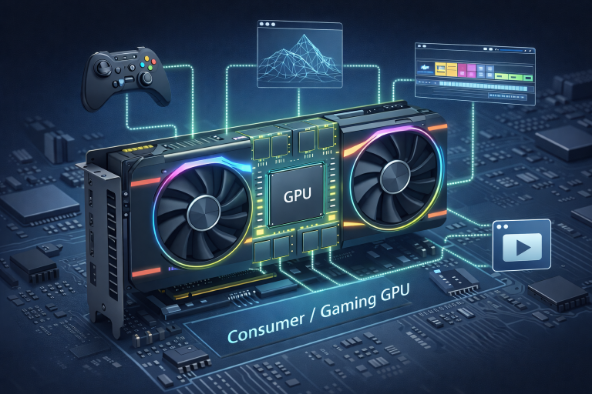
2. Consumer / Gaming GPUs
Consumer GPUs are discrete graphics cards designed to deliver high performance for graphics and compute workloads at a relatively affordable price. They include dedicated high-speed memory and powerful parallel processing cores.
Although optimized for gaming, these GPUs are widely used for creative and compute-heavy workloads due to their strong performance-per-dollar ratio.
Key Characteristics
- Dedicated GDDR6/GDDR6X memory
- High clock speeds
- Strong parallel processing
- Advanced graphics features (ray tracing, AI upscaling)
Real-World Use Cases
- Gaming and virtual reality (VR)
Delivers high frame rates, realistic graphics, and immersive VR experiences with smooth rendering and low latency. - Video editing and motion graphics
Accelerates rendering, effects processing, and timeline playback for faster editing and smoother creative workflows. - 3D modeling and animation
Enables real-time viewport rendering, complex simulations, and faster iterations for detailed 3D assets and animations. - Game development
Supports asset creation, real-time engine previews, and testing across high-fidelity environments and game engines. - AI experimentation and small-scale ML training
Provides GPU acceleration for model prototyping, training, and inference on moderate datasets without enterprise infrastructure. - Content creation and streaming
Handles live streaming, video encoding, and multi-application workflows while maintaining consistent visual quality.
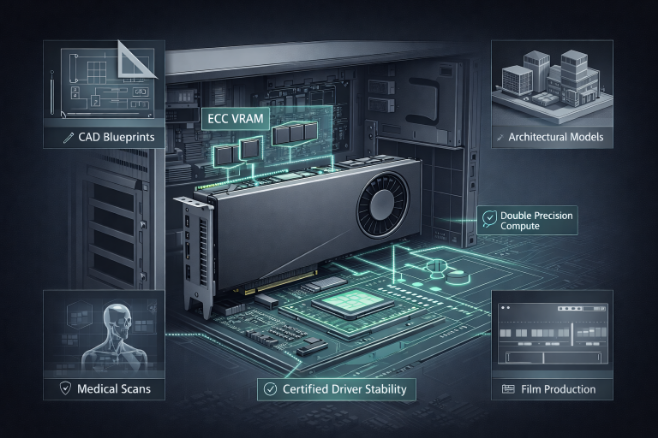
3. Professional Workstation GPUs
Workstation GPUs are designed for accuracy, stability, and long-duration workloads. They prioritize consistent performance and application compatibility over gaming-centric optimizations.
These GPUs undergo extensive testing and certification with professional software, ensuring reliable behavior in mission-critical environments.
Key Characteristics
- Error Correcting Code (ECC) memory support
- Certified drivers for professional applications
- High precision and reliability
- Optimized for complex geometry and visualization
Real-World Use Cases
- Computer-Aided Design (CAD)
Accelerates rendering and manipulation of complex 2D and 3D models, enabling engineers and designers to iterate quickly. - Engineering and architectural visualization
Provides real-time visualization of structures, prototypes, and environments, helping professionals assess designs before construction. - Medical imaging and diagnostics
Enhances image processing, 3D reconstruction, and analysis of scans, supporting faster and more accurate medical diagnoses. - Film production and visual effects
Speeds up rendering, compositing, and simulation workflows for high-quality CGI, animation, and VFX production. - Scientific visualization and simulations
Enables detailed simulations and large-scale data visualizations in fields like physics, chemistry, and climate modeling.
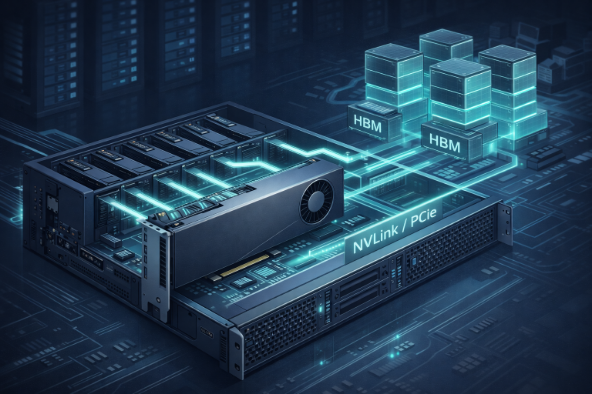
4. Data Center / Enterprise GPUs
Data center GPUs are built specifically for server environments and large-scale computing. They are optimized for throughput, reliability, and scalability rather than display output.
These GPUs support multi-GPU clustering and advanced interconnects, enabling them to process extremely large datasets efficiently.
Key Characteristics
- Large high-bandwidth memory (HBM)
- Designed for 24/7 operation
- GPU virtualization and partitioning
- High-speed interconnects (NVLink, PCIe Gen5)
Real-World Use Cases
- AI and ML model training
Provides high-speed parallel computation for training deep learning models efficiently on large datasets. - Large Language Models (LLMs)
Powers the development, fine-tuning, and inference of complex language models with billions of parameters. - Big data analytics
Accelerates processing and analysis of massive datasets, enabling faster insights and real-time decision-making. - Scientific research and simulations
Supports computational experiments, simulations, and modeling across physics, chemistry, biology, and more. - Financial modeling and risk analysis
Enables rapid scenario simulations, predictive modeling, and portfolio optimization for finance and investment applications. - Cloud computing services
Provides GPU-accelerated infrastructure for high-performance cloud applications, AI services, and virtualized workloads.
5. AI-Focused GPUs and Accelerators
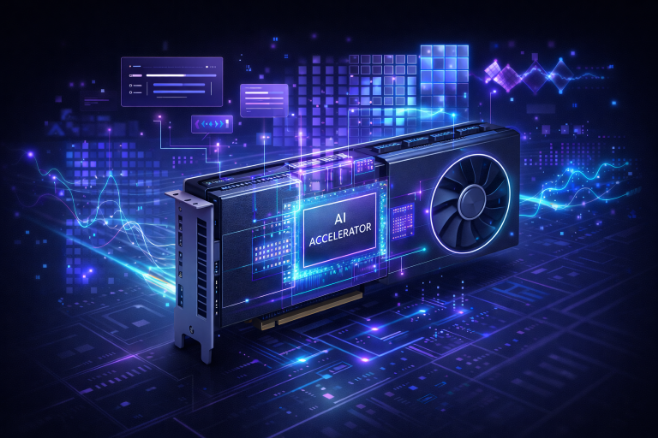
AI-focused GPUs and accelerators are optimized specifically for matrix and tensor operations, which form the core of deep learning algorithms. These GPUs often sacrifice traditional graphics capabilities to maximize AI performance and energy efficiency.
They are purpose-built for both training and high-throughput inference workloads.
Key Characteristics
- Tensor-optimized cores
- Extremely high compute density
- Low-latency inference optimization
- High energy efficiency at scale
Real-World Use Cases
- Generative AI (text, image, video models)
Enables creation of high-quality content across multiple modalities, from realistic images and videos to human-like text. - Computer vision and image recognition
Processes and interprets visual data for applications like object detection, facial recognition, and automated inspection. - Speech recognition and natural language processing
Power voice assistants, transcription services, and conversational AI convert speech to text and understand context. - Recommendation engines
Analyzes user behavior and preferences to deliver personalized suggestions in e-commerce, streaming, and social platforms. - Real-time AI inference systems
Executes trained AI models instantly at the edge or in the cloud, supporting applications like autonomous vehicles and live analytics.
6. Mobile GPUs
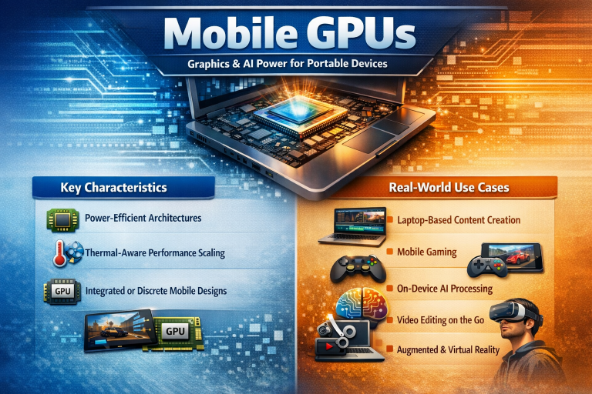
Mobile GPUs are designed for portable devices, balancing performance with strict power and thermal limits. They dynamically scale performance based on available power and cooling capacity.
These GPUs enable advanced graphics and AI capabilities on laptops and mobile platforms.
Key Characteristics
- Power-efficient architectures
- Thermal-aware performance scaling
- Integrated or discrete mobile designs
Real-World Use Cases
- Laptop-based content creation
Enables smooth editing, design, and creative workflows on portable systems without sacrificing performance. - Mobile gaming
Delivers high-quality graphics, responsive gameplay, and immersive experiences on laptops and portable devices. - On-device AI processing
Performs AI tasks locally, such as image recognition or voice commands, reducing latency and reliance on the cloud. - Video editing on the go
Allows quick rendering, effects processing, and previewing of videos anywhere, supporting mobile workflows. - Augmented and virtual reality (portable systems)
Powers immersive AR/VR experiences on compact devices, ensuring fluid graphics and low-latency interactions.
7. Embedded and Edge GPUs
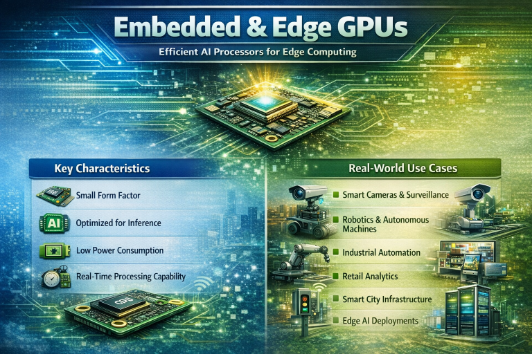
Embedded GPUs are compact, energy-efficient processors designed to operate at the network edge, close to where data is generated. They reduce latency and bandwidth usage by processing data locally rather than in the cloud.
Key Characteristics
- Small form factor
- Optimized for inference
- Low power consumption
- Real-time processing capability
Real-World Use Cases
- Smart cameras and surveillance
Processes video locally for motion detection, facial recognition, and real-time alerts without cloud dependency. - Robotics and autonomous machines
Powers navigation, perception, and decision-making in robots and autonomous systems with low-latency computation. - Industrial automation
Enables real-time monitoring, quality control, and predictive maintenance in factories and production lines. - Retail analytics
Analyzes shopper behavior, inventory, and checkout patterns on-site to optimize operations and customer experience. - Smart city infrastructure
Supports traffic management, environmental monitoring, and public safety applications through localized AI processing. - Edge AI deployments
Executes AI models near data sources, reducing bandwidth usage and latency for faster, autonomous decision-making.
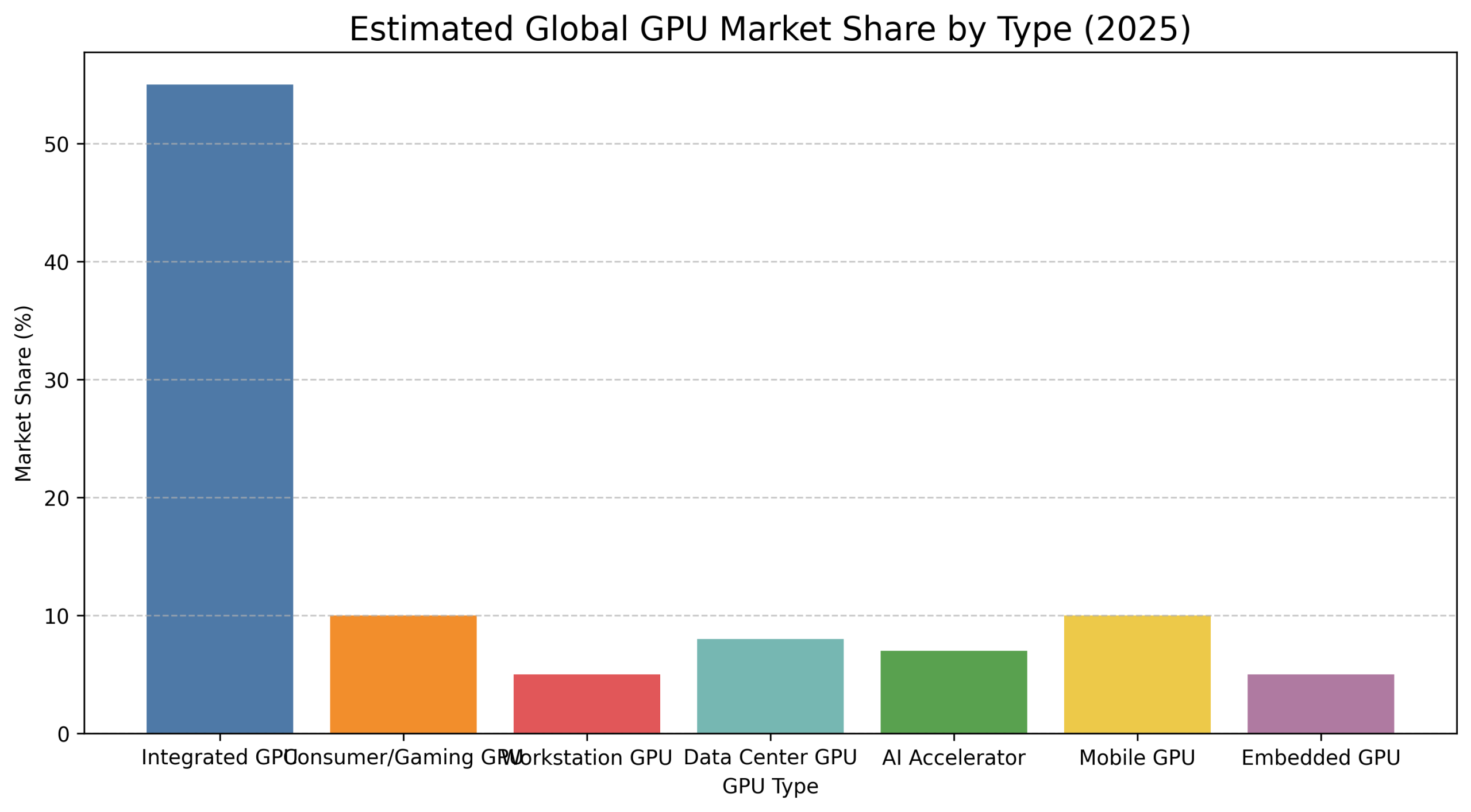
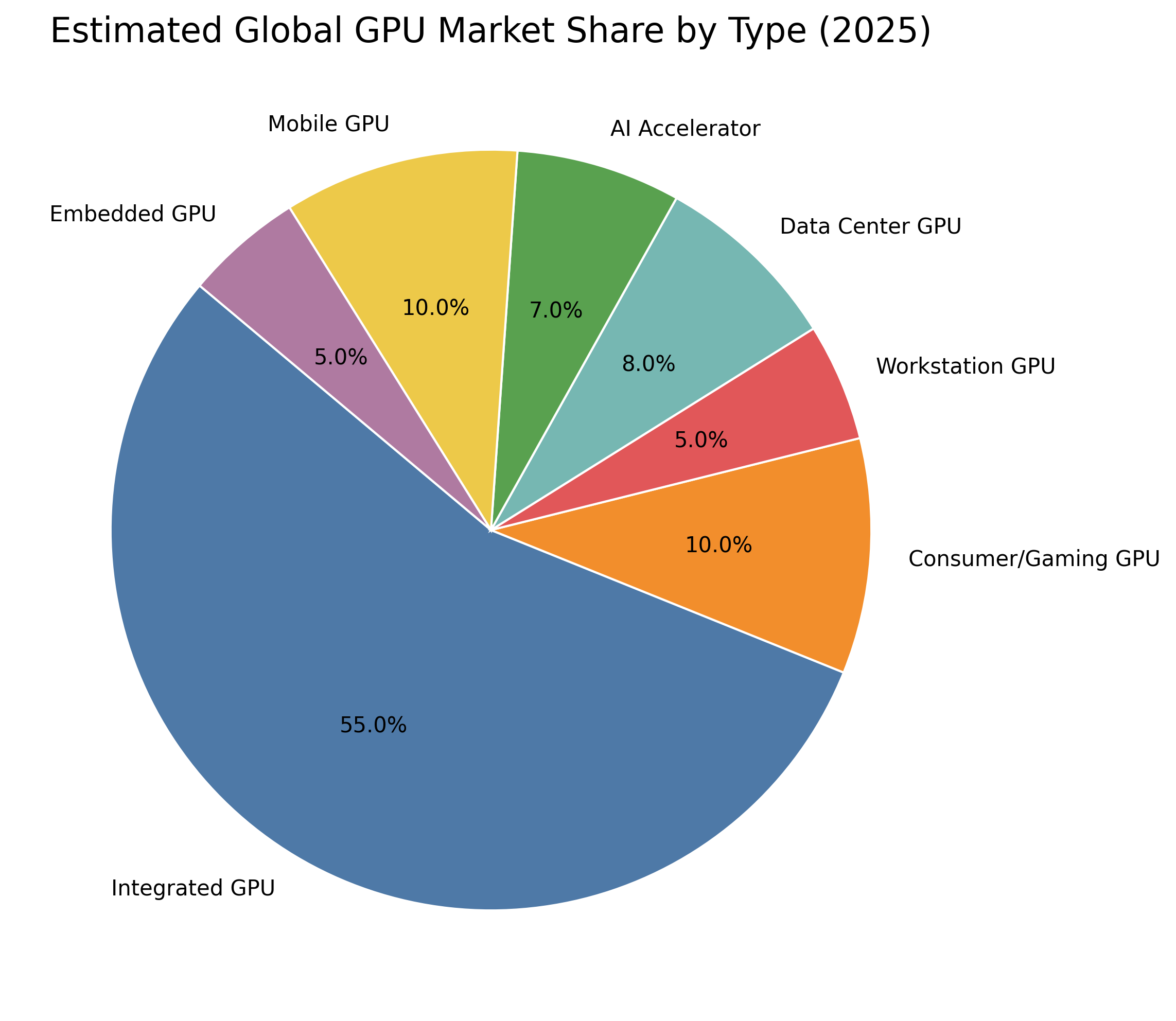
Global GPU Market Share by Type (2025):
- The 2025 GPU market is dominated by Integrated GPUs, which account for approximately 55% of total units due to their widespread inclusion in laptops, desktops, and mobile devices.
- Consumer/Gaming GPUs and Mobile GPUs each hold around 10%, reflecting the ongoing demand for gaming, content creation, and portable computing.
- Data Center GPUs make up roughly 8%, driven by AI training and cloud computing workloads, while AI Accelerators contribute about 7%, reflecting their rapid adoption in specialized deep learning tasks.
- Workstation and Embedded GPUs represent smaller segments at 5% each, highlighting their niche applications in professional design, industrial automation, and edge computing.
Overall, the charts emphasize that while integrated and mobile GPUs dominate in volume, discrete and specialized GPUs are key revenue drivers and critical for emerging AI and enterprise workloads.
Conclusion
GPUs have evolved far beyond their original role of accelerating graphics. From integrated solutions in entry-level laptops to AI-optimized accelerators powering large-scale data centers, GPUs are now a cornerstone of modern computing. Their parallel processing capabilities enable everything from everyday productivity and gaming to advanced scientific simulations, deep learning, and real-time AI applications. As workloads continue to grow in complexity and data intensity, GPUs remain essential for delivering high performance, efficiency, and scalability across industries, making them indispensable in both personal and enterprise computing.